by
Dawn Christine Simmons (Khan), Transformation Strategist and Business Process Advisor
Date Published January 20, 2026 - Last Updated February 2, 2026
Agentic AI Service has crossed a line. The comfortable Industrial Service Management Model of Work is no longer “routed” through queues, handoffs and ticket updates — it is run end-to-end: intent → action → verified outcome. That shift is already unfolding across most enterprises, and redefining what CxOs should measure and fund.
CxO overview
Customers and employees do not buy tickets. They buy results. AI is no longer a bonus feature; it is an expectation.
Microsoft Trend Index found 75% of global employees use AI and work usage has doubled in six months.
Meanwhile, the industry is updating the operating model: PeopleCert is updating ITIL 4 practice guides for AI. The HDI “State of Technical Support” says 41% plan to deploy generative AI, 19% already use it and 47% have formed AI oversight.
How to spot an organizational change in basic assumptions
If your team still runs “industrial” service operations — a ticket factory — AI will not fix the pain. It will amplify it.
Watch these signals:
- You measure activity, not outcomes: success = SLA and “tickets touched,” not verified resolution.
- Routing lives in tribal knowledge: decisions happen in people’s heads or war rooms, not in rules you can run.
- Knowledge is not usable: articles are long, stale and disconnected from the steps agents follow.
- Trust foundations are weak: access to decisions and data sources lack clear ownership, governance, and control.
Six Capabilities of Agentic AI Readiness
ITIL becomes executable: ITIL value moves from “documented” to agentic model “runnable.” Transform tribal runbooks into decision logic, policies, workflows, verification and evidence.
Agent Readiness Capabilities
- Outcome-first design: outcome + happy path + exception path.
- Executable logic: routing + eligibility + risk tiers/controls + verify.
- Actionable knowledge: “If X, do Y” tied to workflow steps.
- Trusted access/data known roles + least privilege + approved sources.
- Guardrails & audit: allowed actions + approvals + evidence + rollback.
- Value & safety metrics: deflection quality, TTR, rework, evidence rate verified outcomes.
Use Case: NIH: “agentic-ready service”
US National Institute of Health (NIH) is an exemplary agentic solution built for trust with proof of value. Their Agentic intranet-based assistant supported 8,000 users, deflecting 10,000 service requests per year. They started with approved content, run in a secure environment, improving repeatable low-risk demand and keep humans on data stewardship of exceptions and mission work.
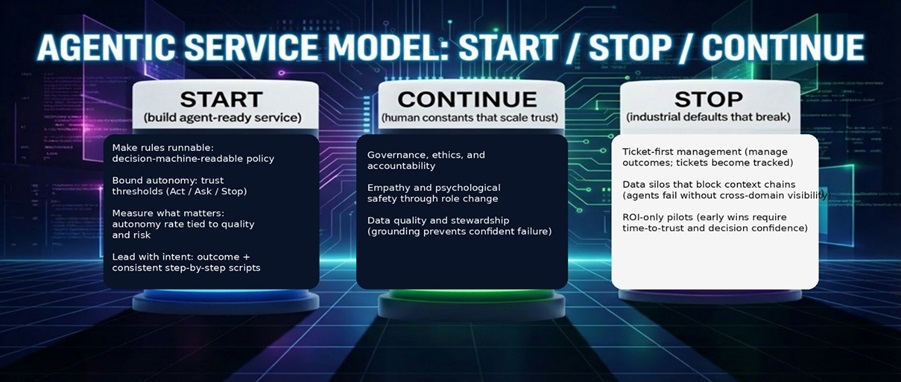
Start / Stop / Continue: The load bearing pillars
NIH defined the service model for repeatable demand, safety and prove outcomes.
Where Agentic AI fails fast
Gartner warns that over 40% of agentic AI projects may be canceled by 2027 when costs rise, value is unclear or risk controls are weak. Yet the shift will not stop. Gartner also forecasts agentic AI will drive 15% of day-to-day business decisions by 2028.
Teams do not fail because they picked the wrong tool. They fail because autonomy outruns policy, ownership, data quality and controls. If projects pause in 2027, it will not mean the paradigm is over. It will mean organizations are rebuilding the foundations required for safe, scalable agentic service delivery.
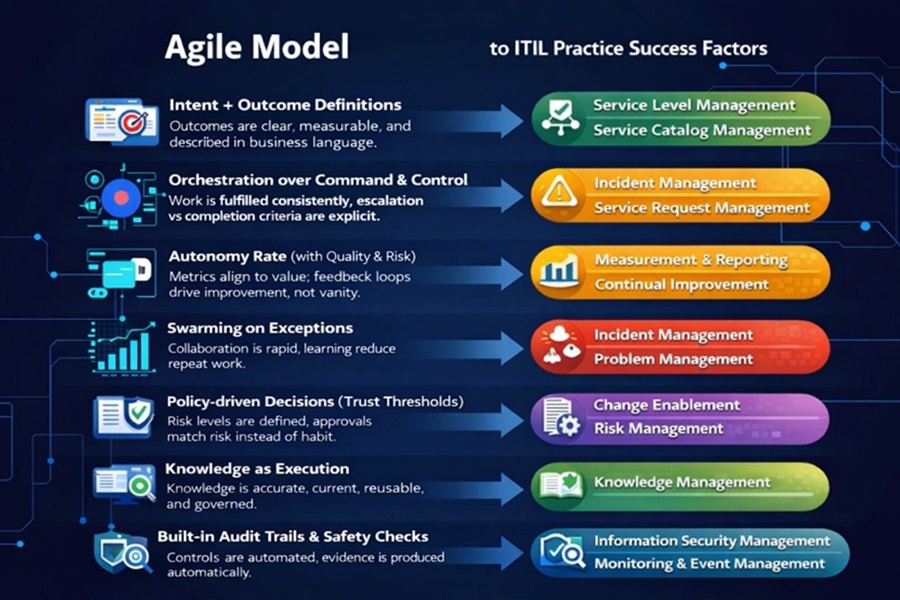
Align the Agentic Model to ITIL Success Factors: 30-day play.
- Pick one high-volume service (access, password, standard software).
- Define the outcome and proof (what closes the loop).
- Build a happy path and exception path.
- Convert key decisions into simple, machine-readable rules.
- Attach short, approved knowledge to key steps.
- Add guardrails before auto-act (approvals, logging, rollback).
- Measure value and risk weekly, then begin your next next service
Close
This is Service leadership moment to multiply ITIL value. Turn expert judgment into controlled, repeatable service logic backed by strong data stewardship. Support and Service Delivery may resolve faster, automate safely, and deliver value that elevates user and agent experience.
ITIL Fulfillers focus on exceptions, risk, continuous improvement and the work only humans can do.
Start now: pick one high-volume service, define the outcome + proof, build the happy path + exception path, add guardrails, measure weekly, repeat.
Author Bio
Dawn Christine Simmons (Khan) is a Senior Transformation Strategist and trusted advisor to C-suite leaders driving AI-powered service excellence. A champion for women in IT and a longtime HDI community voice, she specializes in humanizing technology, operationalizing AI governance, and accelerating enterprise change with clarity, trust, and impact.