AI conversations in IT Service Management tend to begin in the same place: automation. The promise sounds familiar. Faster resolutions, fewer tickets reaching the service desk, less manual work for agents.
Organizations respond by experimenting. They pilot chatbots, copilots and task-specific AI features. Some capabilities reach production. Many stall somewhere between evaluation and operational value. You might be in this boat.
Research consistently shows a steep drop between AI experimentation and real deployment. Gartner data reflects the same pattern: most organizations evaluate generative AI tools, far fewer move into pilot, and only a small fraction integrate them into production workflows where they influence real outcomes.
The technology works. Adoption breaks down in the operational environment where it runs, because AI systems inherit the conditions of the service desk.
Inconsistent categorization, fragmented knowledge, and uneven processes appear directly in AI outputs. Weak foundations produce weak recommendations, and automation accelerates existing habits.
Sustainable AI adoption begins with a different objective. Service leaders expand operational intelligence before expanding autonomy. Intelligence grows inside the workflows where service work already happens.
Why AI adoption breaks in service environments
Most AI adoption strategies in ITSM still start with automation. The assumption is that adding AI will immediately reduce workload and improve efficiency. In practice, the opposite often happens.
This is why approaches centered on copilots or standalone AI tools often stall. When intelligence lives outside the workflow, it depends on agents to adopt it consistently. When it feels optional, it rarely delivers measurable value.
A more effective approach embeds intelligence directly into service workflows and builds outward from there, allowing operational maturity and trust to develop alongside AI capabilities.
A practical model for building intelligence in service desks
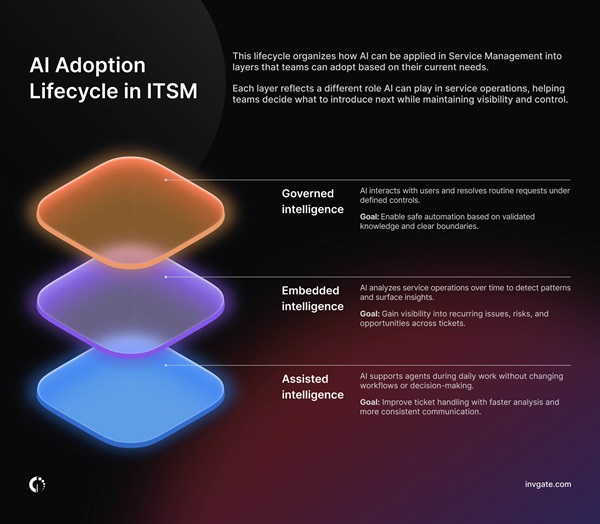
These patterns form a practical adoption model that many service organizations follow, whether intentionally or not. Rather than treating AI as a single capability, it helps to view it as layers of intelligence that expand across the service desk as trust and operational visibility increase.
This is the model we developed to describe how AI creates value in service environments. It’s not a linear maturity path, but a set of capabilities that can coexist and evolve.
The model includes three layers of intelligence:
-
Embedded intelligence analyzes operational activity across the service environment. Systems detect patterns in incident activity, extract knowledge from resolved tickets, and surface signals that help teams manage service health.
Different teams often operate across these layers simultaneously. One group may rely heavily on AI assistance inside tickets while another begins automating high-volume requests.
Governance allows these capabilities to coexist by defining what knowledge the system can use and what actions remain under human control.
Layer 1: Assisted intelligence inside the ticket
At the first layer, intelligence supports agents directly inside the ticket workflow, assisting without changing ownership or decision-making.
The first practical step places AI directly in the ticket. Agents receive support while working through requests instead of interacting with AI as a separate tool.
AI can summarize long ticket descriptions, suggest keywords for classification, retrieve relevant knowledge articles and draft response language. Agents review the suggestions, refine them and decide how to proceed. The system assists in the work without taking control of the decision-making.
And this means agents spend less time interpreting messy descriptions and searching through documentation while also improving their responses.
Many organizations generate measurable value at this stage alone. Faster responses and better communication improve the experience for both agents and users while also creating cleaner tickets and clearer documentation for better future analysis
Layer 2: Embedded intelligence across operations
As intelligence matures, it expands beyond individual tickets and begins analyzing service operations as a whole.
Service desks generate patterns that remain difficult to see during daily work. Embedded intelligence examines those signals across historical and live ticket activity. Systems can cluster similar incidents, detect potential major incidents, and surface recurring problems that deserve formal Problem Management. AI can propose knowledge articles based on successful resolutions and estimate resolution timelines using historical performance data.
Everyone gains broader visibility into everything, emerging problems appear earlier, knowledge grows continuously from ticket history and service operations begin functioning with greater awareness of their own activity.
Teams gain the ability to anticipate issues instead of discovering them after disruption spreads.
Layer 3: Governed intelligence and automation
Once knowledge and processes stabilize, intelligence can safely extend into direct interaction with users through governed automation.
Service desks eventually encounter request types that follow consistent paths. Password resets, access requests and common troubleshooting procedures repeat frequently. Clear documentation exists.
AI can interact with users in these scenarios when governance defines the boundaries. Virtual agents guide users through known procedures, retrieve relevant knowledge and structure requests before they reach a human agent. Routine incidents and requests can be closed immediately while also enabling more complex issues to arrive with clearer context and better categorization.
Automation works best when it operates inside well-understood service processes. Reliable knowledge and defined workflows allow the system to act with confidence while maintaining clear escalation paths.
Assessing where intelligence operates today
Service leaders benefit from viewing AI adoption as a distribution of intelligence across these layers rather than a race toward autonomy.
The important question becomes simple: where does intelligence operate today?
Some teams primarily use AI as an assistant during ticket work. Others already rely on operational insights generated from service data. A few may run limited automation scenarios supported by strong knowledge and governance.
Mapping these capabilities provides a clear picture of how intelligence currently supports service operations and where additional value may appear next.
To help with this evaluation, we developed a short self-assessment that maps how AI operates in ITSM across assisted, embedded and governed intelligence. The exercise takes only a few minutes and helps service leaders identify strengths, gaps, and opportunities in their current approach to AI adoption.
Intelligence before autonomy
AI adoption succeeds when intelligence grows inside the workflows where service work already happens. Systems learn from operational history, assist agents with context, and gradually expand their reach across the service desk.
Automation becomes reliable once knowledge proves stable and processes remain predictable. Service teams maintain oversight while AI handles well-understood interactions within defined boundaries.
Service Management has always focused on bringing structure to complex environments. AI strengthens that effort when it expands operational understanding and supports the people responsible for delivering service.