It was day one of a brand-new job. As I was in my car, driving to meet the Service Desk team and pick up all my equipment for onboarding, I had 118 miles of mostly boring highway to sit with my own thoughts.
From Managed Service Provider to Non-Profit. From a global organization with over 20,000 employees to an organization with fewer than 200 employees, based in Ohio, just two hours down the road. From managing a team of three hundred to having no direct reports. Change wasn’t approaching…I was diving 65 miles per hour straight into it.
In moments of big change, if you’re anything like me, your mind starts racing. Excited. Nervous. Landing somewhere between hopeful and terrified. The question that kept surfacing was simple, but heavy:
“How can I add value and make an impact if I am no longer a people manager with a team?”
I let the question sit. To use a term borrowed from Sarah Caminiti, I gave the question space. As miles of farm fields construction cones passed, that space provided exactly what I needed.

What I recognized in that space is something I am deeply convinced every leader eventually must recognize:
The impact you make is not determined by the title you hold, the size of your team or the revenue you generate. It’s shaped by the small choices you make, repeatedly, over time.
Impact is not nearly as complicated as we often make it. The way to transform your leadership, organization, impact on customers, or see your team shift from surviving to thriving, happens one degree at a time.
When you’re flying, being one degree off course isn’t something you feel or notice as a passenger. The cabin is smooth, the speed is steady, the drink cart makes its way from first class to economy and the clouds are still there. Yet the pilot’s choices quietly determine whether you land where you intended or somewhere entirely different.
We tend to look for impact in big moves: Promotions, restructures, initiatives or moments of authority. But when you trace meaningful change backward, it almost never starts there. It starts with small shifts in how leaders show up, decide, listen and respond; shifts so subtle they’re easy to dismiss, yet powerful enough to alter trajectories over time.
The evidence lays hidden within the details.
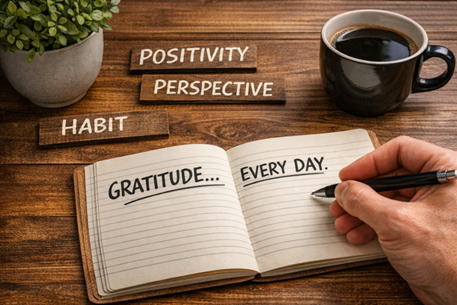
There are several one‑degree shifts that yield obvious long term impact. These examples aren’t about habits, they are about trajectories.
Shift: Write down three things you are thankful for every day.
Outcome: Perspective lands on the positive. It becomes engrained, natural and easier to identify the good things around you. Maybe not after a day or two…but eventually, gratitude is your default attitude.
Shift: Walk 10,000 steps a day and spend at least 30 minutes outside.
Outcome: Energy becomes your baseline, not something you chase. You burn more calories and feel better. Maybe not on day one…but once it’s your norm, the effects are undeniable.
Shift: Budget, so you don’t spend more than you make.
Outcome: Savings will increase. Habits will form within that container of self-control and eventually, you realize you can retire.
These are everyday life examples. They are simple, yet great illustrations of small shifts yielding long-term impact. Think about your life and the hats you wear. Parent, friend, boss, employee, mentor, chaos manager, firefighter (because you’re in IT), budget keeper…the list goes on and on. In every one of those roles, small changes can make a lifetime of impact.
Define “success” explicitly before starting. Ask “how can I help?” instead of “why isn’t this done?” Say, “tell me more” when an employee is venting, instead of reaching to solve the problem immediately. Ask the quiet person in the meeting for their perspective. When you present a problem, bring a potential solution to go with it. Schedule time to think deeply and flex your creativity, because the problems and meetings will be there when you are done.
In every role you play in the motion picture of life, the list of small shifts that make long term impact, is endless.
What matters isn’t where you start. It’s that you start. Growth doesn’t happen in a moment. It’s a journey. The shifts you choose today, will echo for the rest of your life.