by
Dawn C. Simmons (Khan), Customer Service Management Strategist | AI Engineer | Digital Business Transformation Leader
My son, Jahir Rayhan, is the fastest 400-meter runner in Bangladesh’s history. At 17, he broke the country’s 32-year national record, and he later represented Bangladesh at the Tokyo 2020 Olympics. That kind of achievement does not happen by accident. It comes from discipline, structure, repetition, and the will to improve every day.

That is also how great service organizations perform.
In Customer Service Management and digital transformation, strong results never come from speed alone. They come from the system behind the sprint. High-performing teams train their people, strengthen process, improve data, apply technology with purpose, and build a culture that can perform under pressure.
That is what it means to train like a champion.
The Five Rings of Service Excellence
Pierre de Coubertin designed the Olympic rings to represent the five continents united in sporting competitions. Each ring is distinct. Each interlock with the others. Remove one and the symbol breaks. The same is true of modern Customer Service Management.
The Olympic rings offer a powerful model for modern service leadership. Each ring matters on its own, but real strength comes when they work together.
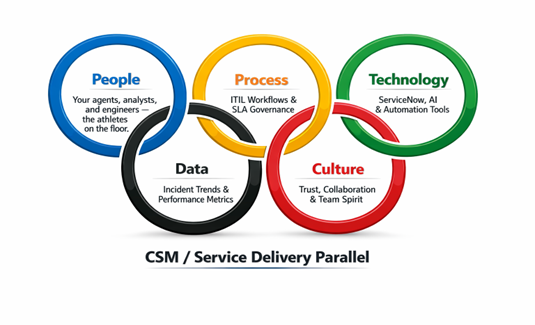
Every high-performing service organization I have worked with from financial services firms to government agencies has succeeded because it trained all five simultaneously.
AI Is the New Coaching Technology
Elite athletes do not rely on effort alone. They use coaching, feedback, timing and data to improve performance. Service leaders should take the same approach.
AI should not replace people. It should help them perform better.
Used well, AI can reduce manual triage, improve recommendations, accelerate responses and make self-service more effective. However, those gains only happen when the foundation is strong. Weak taxonomy, poor knowledge and messy data produce weak outcomes.
That is why AI readiness is not just a technology decision. It is an operational discipline.
ITIL Is the Training Plan, Not the Finish Line
ITIL is not a checklist, but a practiced discipline. Service teams must train for incident management, request fulfillment, knowledge use, continual improvement and value-stream thinking until they become daily habits. Like athletic training, ITIL builds strength through repetition, review, and adjustment. That is how service excellence becomes real. Champions do not train once and declare victory. They review performance, adjust, strengthen weak spots and keep improving. Service excellence requires the same mindset.
Learning to apply ITIL is part of the training regimen. Just as athletes build new strength, speed and recovery skills over time, service teams must build new habits in incident management, request fulfillment, knowledge use, continual improvement and value-stream thinking. ITIL is not just something to know. It is something to practice until better decisions, stronger collaboration and more consistent service become part of how the team performs every day.
How to Train Like a Champion
Start by measuring your current state. Review service quality, routing accuracy, knowledge health and customer experience trends.
Next, define what winning looks like. Faster resolution, stronger first-contact resolution, fewer escalations and better customer satisfaction are real outcomes. Technology should support those outcomes, not distract from them.
Then, govern your data before you automate anything. AI will amplify whatever is already in your environment, whether it is strong or weak.
After that, start small. Choose one high-value use case, measure the results, build trust and improve from there.
Finally, coach your people. Change does not stick because of an announcement. It sticks when teams understand the value, learn the method, and see the results.
The Corporate Athlete’s Closing Thought
Jahir’s success was built long before race day. The record, the Olympic stage and the recognition all came from disciplined preparation.
The same is true in service management.
Organizations do not become exceptional by talking about transformation. They become exceptional by training for it. They build people, process, data, technology, and culture with intention.
Train with discipline. Lead with purpose. Deliver like a champion.
Author Bio
Dawn Christine Simmons (Khan) is a Senior Transformation Strategist and trusted advisor to C-suite leaders driving AI-powered service excellence. A champion for women in IT and a longtime HDI community voice, she specializes in humanizing technology, operationalizing AI governance, and accelerating enterprise change with clarity, trust, and impact.