by
Dawn Christine Simmons (Khan), Transformation Strategist and Business Process Advisor
Opening Insight
Organizations everywhere are racing to deploy AI in service operations. Virtual agents, automation and predictive analytics promise faster support and lower costs. My experience leading through two major business continuity and disaster recovery events shaped a lasting conviction: Incident Management must be treated as an essential system of record.
I developed and delivered the major incident process my organization used during the World Trade Center attack on September 11, 2001. I later built on that work through ITSM leadership in financial services and healthcare, co-authoring an article on the importance of Application Impact Assessment in Disaster Recovery and Business Continuity. During COVID-19, I adapted and strengthened those practices again for food supply chain operations.
The lesson remained consistent. AI cannot improve what the organization does not capture. In disaster, and even in day-to-day service operations, hidden incidents weaken visibility, delay learning and limit resilience. Our reference document, now used by theNational Institute National Library of Medicine, reinforces that truth. Every intelligent service operation begins with disciplined incident logging.
Introduction
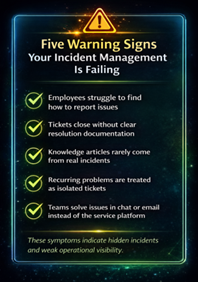
AI is transforming service management, but automation cannot succeed without reliable operational data. The foundation of that data is disciplined incident management. When incidents are hidden, solved through chat messages or resolved through email threads instead of the service platform, organizations lose operational intelligence. Problems repeat, knowledge never grows and automation fails. A modern service organization must begin with one principle: every issue must be logged, managed and resolved in a trusted system of record.
Figure 1 - Incident Management Maturity Journey: Structured incident logging creates the operational signals that enable knowledge, problem elimination, AI automation, and autonomous service operations.
Incident - Log Every Issue
Employees must be able to report issues immediately and receive a trackable incident record. Every incident should document the problem, the business impact, the actions taken and confirmation that the issue was resolved. Without consistent incident logging, organizations lose the operational signals required to identify service risk.
Knowledge - Capture What Was Learned
Resolved incidents should generate knowledge. Each incident contains troubleshooting steps that can help the next user resolve the same issue faster. Without structured incident records, knowledge bases remainincomplete and self-service capabilities fail.
Problem - Eliminate Recurring Failures
When incidents repeat, organizations must investigate root causes. Problem management allows teams to eliminate systemic failures rather than repeatedly fixing the same symptoms.
AI Enabled - Automate and Predict
AI systems and virtual agents rely on historical incident data. With mature incident records, AI can recommend knowledge articles, route incidents intelligently and automate common fixes. Without incident data, AI has nothing to learn from.
Operational Risk of Hidden Incidents
Solving problems outside the system of record may appear efficient, but removes visibility into operational failures. Hidden incidents create inaccurate metrics, prevent knowledge growth, weaken service reliability and hide the true cost of disruption.
The Bottom Line
Incident management is not administrative overhead. It is the operational foundation that enables knowledge reuse, root-cause elimination and intelligent automation. Success of AI service begins with disciplined service management and a true incident system of record.
Author Bio
Dawn Christine Simmons (Khan) is a Senior Transformation Strategist specializing in operational visibility, disciplined governance, human-centered service design, and practical strategies that prepare organizations for knowledge reuse, problem elimination, and intelligent automation.