Date Published September 17, 2026 - Last Updated September 17, 2026
Customer Satisfaction (CSAT) is one of the most widely used measures of contact-center performance. Organizations collect millions of CSAT responses every year, analyze the results and report the scores to management.
But there is a question that many organizations have yet to answer: What are we doing with the customer’s CSAT history when that customer contacts us again?
Too often, the answer is: We do nothing.
CSAT is typically treated as a measurement of what happened in a previous interaction. With the integration of AI, customer analytics and CRM platforms, CSAT can become much more than a reporting metric. It can become an actionable source of intelligence that influences the customer’s next interaction.
The opportunity is to move from measuring customer satisfaction to actively managing it.
Make CSAT History Actionable
When a customer contacts an organization, the contact center should know more than the customer’s name, account number and transaction history. It should know something about the customer’s recent experience.
If a customer gave a poor CSAT rating during a previous interaction, that information should be available to the agent — or to the AI supporting the interaction. The objective is not to label the customer or prejudge the interaction. Instead, the information should provide context that helps the organization deliver a better experience.
Agent Notification Example:
Previous interaction resulted in customer dissatisfaction. Confirm that the current issue has been completely resolved before closing the interaction.
That small piece of information can change the interaction. Rather than treating CSAT as historical information, the contact center is using it to influence the customer’s next experience.
Make CSAT Part of the Customer Profile
CSAT information should become an integrated component of the customer profile. Customer profiles already contain information such as purchase history, account information, previous contacts, preferences and service issues. Satisfaction history can provide another important dimension: the customer’s experience with the organization.
This information can be made available to both human agents and AI-powered virtual agents. An agent doesn’t necessarily need to see a complicated history of every survey response. Instead, the contact-center platform can translate that information into useful guidance:
- Recent satisfaction is declining.
- Customer experienced dissatisfaction during the previous interaction.
- Customer has had multiple unresolved issues.
- Customer satisfaction has improved following previous interventions.
- Customer is consistently highly satisfied.
The objective is to turn data into context and recommended action.
Turn CSAT Data Into Suggested Actions
Historical CSAT becomes significantly more valuable when it produces a recommended action. AI can analyze CSAT history alongside contact history, sentiment, interaction transcripts and other customer information to identify patterns.
For example, a declining satisfaction trend could trigger a recommendation to:
- Confirm resolution before ending the interaction.
- Escalate the issue to a more experienced representative.
- Initiate a proactive follow-up.
- Provide additional information or assistance.
- Route the customer to a specialized team.
- Review previous unresolved interactions.
Conversely, consistently high satisfaction could identify customers who are strong candidates for loyalty programs, advocacy initiatives or other relationship-building activities.
The important distinction is that the system is not reporting: “This customer has a CSAT score of 72.”
It is asking: “Given what we know about this customer, what should we do differently during this interaction?”
That is where AI can turn CSAT analytics into an operational capability.
Give Both AI and Agents Access to Customer Satisfaction Intelligence
The customer should receive a consistent experience regardless of whether the interaction begins with a chatbot, virtual agent or human representative.
- If an AI bot knows that a customer recently had a poor experience, but the human agent who receives the escalation does not, valuable context has been lost.
- Likewise, if the human agent knows the customer has experienced repeated dissatisfaction but the AI does not, the organization is operating with two different versions of the customer experience.
CSAT intelligence should therefore follow the customer across channels. AI can use satisfaction history to modify its conversational approach, determine when escalation is appropriate and recognize when a customer may require additional attention. Human agents can use the same information to understand the customer’s recent experience and tailor the interaction accordingly.
This creates an important bridge between automation and empathy.
Create a CSAT Migration Strategy
The next step is to move beyond simply identifying dissatisfied customers. Organizations can develop a CSAT Migration Strategy designed to move customers from lower levels of satisfaction toward higher levels.
|
Satisfaction Band
|
Customer Status
|
Action / Strategy
|
|
Red
|
At risk / Dissatisfied
|
Immediate intervention; route to senior agent.
|
|
Yellow
|
Needs improvement
|
Targeted follow-up and proactive assistance.
|
|
Green
|
Satisfied
|
Frictionless, consistent service.
|
|
Blue
|
Highly satisfied / Advocate
|
Loyalty programs, referrals, and advocacy.
|
The objective is not to manipulate a CSAT score. The objective is to improve the underlying customer experience that produces the score.
Move From CSAT Measurement to CSAT Migration
This represents a fundamental change in the way organizations think about customer satisfaction. Traditional CSAT programs ask: “How satisfied was the customer?” A more advanced approach asks: “Where is this customer today, and what can we do to improve their next experience?”
That change turns CSAT from a retrospective metric into a forward-looking operational tool. The contact center can establish targeted interaction strategies for each satisfaction band and measure whether those strategies are working.
Over time, organizations can identify which interventions produce the greatest improvement (Red → Yellow → Green → Blue). The movement itself becomes an important measure:
- How many customers moved into a higher satisfaction band?
- Which interventions produced the greatest improvement?
- Which customer segments remain at risk?
- Which issues repeatedly cause satisfaction to decline?
- Which agents, processes, or channels produce the best outcomes?
Build the Strategy Into the Contact Center Platform
For CSAT migration to work, it cannot exist as a separate analytics project. The intelligence needs to be integrated into the contact-center ecosystem (CRM, customer history, interaction analytics, AI, routing and quality management).
Workflow
This creates a continuous improvement loop rather than a static survey process.
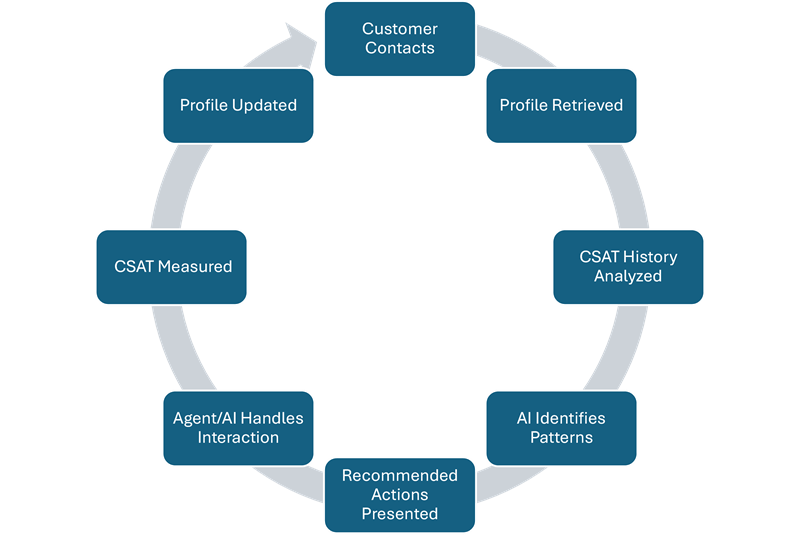
CSAT should not be the end of the customer-feedback process. It should be the beginning. By incorporating CSAT history into customer profiles, making satisfaction intelligence available to both AI and human agents, and developing recommended actions based on customer experience patterns, organizations can turn customer feedback into an operational advantage.
A CSAT Migration Strategy creates a deliberate framework for moving customers toward higher levels of satisfaction. The ultimate goal is a contact center that learns from every interaction to make the next one better.
About the Author
Doug Tanoury is a Contact Center Architect and the founder of Customer Interactions LLC. He helps large public and private sector organizations transform customer-service operations through artificial intelligence, intelligent routing, CRM, analytics, workforce management, training, and quality management. His work brings together people, processes, and technology to improve customer experiences and staff performance.